AssetManager Class Reference
Holds definitions to all the items, objects and skills in the game. This class is used to fetch the definitions and create instances of the items, objects and skills. More...
#include <AssetManager.hpp>
Collaboration diagram for AssetManager:

Static Public Member Functions | |
| static void | loadAssets () |
| Loads all the assets into memory. More... | |
| static const std::vector< ObjectLocation > & | getObjectLocations () |
| Get the Object Locations object. More... | |
| static const std::map< int, GameSkill > & | getSkills () |
| Get the Skills object. More... | |
| static const GameObjects & | getObjects () |
| Get the GameObjects object. More... | |
| static const GameItems & | getItems () |
| Get the GameItems object. More... | |
| static const GameCharacters & | getGameCharacters () |
| Get the GameCharacters object. More... | |
| static std::shared_ptr< Item > | createItemInstance (int id) |
| Creates an instance of an item. More... | |
Static Private Attributes | |
| static GameItems | itemsM = {} |
| static std::map< int, GameSkill > | skillsM = {} |
| static GameObjects | objectsM = {} |
| Tells what possible objects exists and what attributes they have (For example tree) More... | |
| static std::vector< ObjectLocation > | objectLocationsM = {} |
| Tells where objects instances are located on the map (For example, tree at 1,1, tree at 2,2, tree at 4,5 etc) More... | |
| static GameCharacters | gameCharactersM = {} |
Detailed Description
Holds definitions to all the items, objects and skills in the game. This class is used to fetch the definitions and create instances of the items, objects and skills.
Member Function Documentation
◆ createItemInstance()
|
static |
Creates an instance of an item.
- Parameters
-
id Item id
- Returns
- std::shared_ptr<Item>, nullptr if item id is not found.
Here is the call graph for this function:

Here is the caller graph for this function:

◆ getGameCharacters()
|
static |

◆ getItems()
|
static |
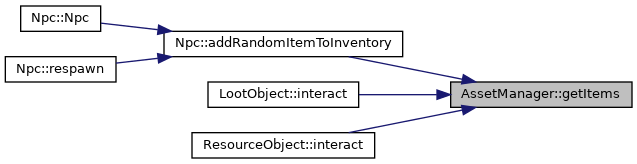
◆ getObjectLocations()
|
static |
Get the Object Locations object.
- Returns
- std::vector<ObjectLocation>
Here is the caller graph for this function:

◆ getObjects()
|
static |

◆ getSkills()
|
static |
Get the Skills object.
- Returns
- std::map<int, GameSkill>
Here is the caller graph for this function:

◆ loadAssets()
|
static |
Loads all the assets into memory.
Here is the call graph for this function:

Here is the caller graph for this function:

Member Data Documentation
◆ gameCharactersM
|
inlinestaticprivate |
◆ itemsM
|
inlinestaticprivate |
◆ objectLocationsM
|
inlinestaticprivate |
Tells where objects instances are located on the map (For example, tree at 1,1, tree at 2,2, tree at 4,5 etc)
◆ objectsM
|
inlinestaticprivate |
Tells what possible objects exists and what attributes they have (For example tree)
◆ skillsM
|
inlinestaticprivate |
The documentation for this class was generated from the following files: